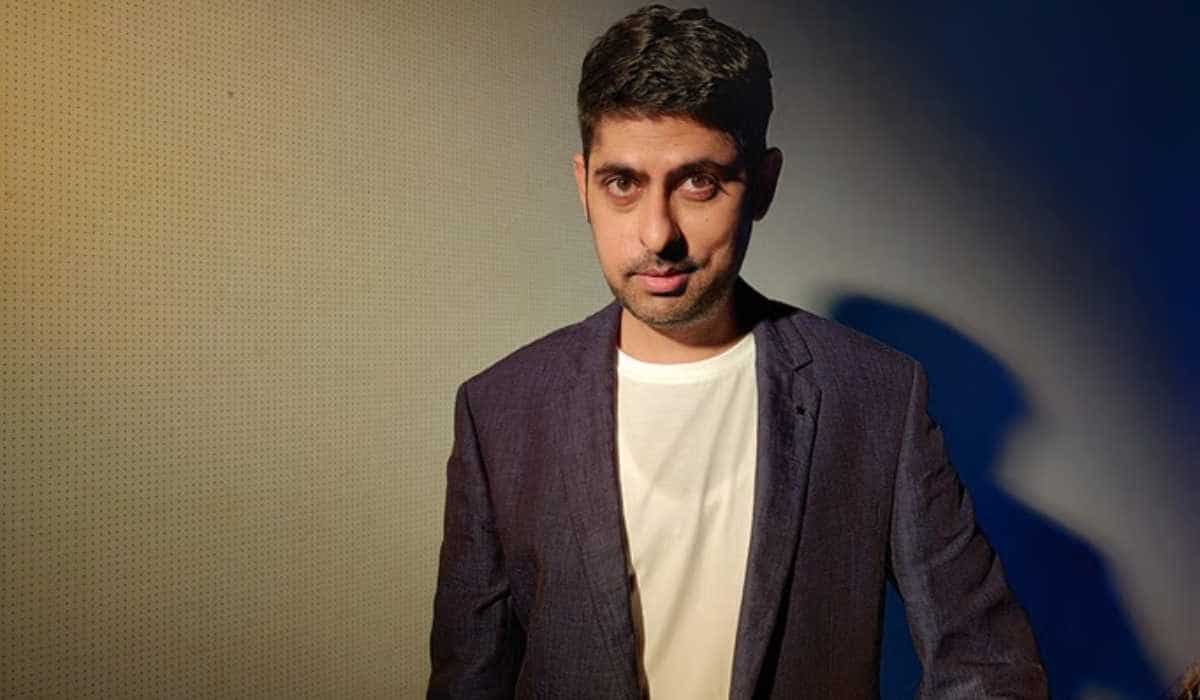


Varun Grover Explains How Society Shapes Censorship in Exclusive KISS Interview
6 months ago | 5 Views
Varun Grover gave OTTplay an exclusive interview about his experience in bringing this intimate and intriguing tale to life in advance of the release of his first short film as a director, KISS, on the renowned international platform MUBI. Grover, who is well-known for his acute humor and astute narrative, expressed his joy at finally bringing KISS to a larger audience after its festival run, the motivation behind its subtle treatment of censorship and compassion, and the impact of his own cinematic experiences on his creative perspective. He also discussed the changing face of freedom in India, the potential of humor, and the changing trends in popular culture stories in this open discussion.
How does it feel to have your first movie, KISS, finally available on OTT?
This is my first film as a director, and I'm extremely fond of it. I'm particularly excited that it will be on MUBI, which has been one of the most prestigious film platforms and, in addition, a consistent library for me where I can view the best of world cinema. Therefore, I am really thrilled that my debut picture will be available on MUBI, and I am eager to see how the audience responds. The movie has played at film festivals and elsewhere, but now it's like the very first time the film has been released in its entirety. Therefore, I'm overjoyed.
Thus, how have you maintained such patience?
Short films lack a strong market, therefore I believe that waiting for your debut short film to be released is a rite of passage for a short film. No one actually wants to—even the major OTTs kind of conceal it in the back, even if they receive a short film. The movie becomes lost because nobody can find it unless they are aware that it is available on the platform. Thus, we were looking for a favorable circumstance, and Newton Cinema, the production company, was also looking for a decent venue. And then the film arrangement just so happened to materialize. The film was also scheduled to debut at the Rotterdam Film Festival, one of the most well-known film festivals, in 2022, as this was the last year. After that, they shortened the area where the film was supposed to be shown due to the COVID outbreak. They then pledged that they would still show the film later. Thus, this year, 2025, it was shown in Rotterdam in a newly established area that had previously been off limits to them. For me, it's almost like the movie was meant to premiere at Rotterdam as the first festival, but it ended up playing at Rotterdam as the last event it attended. And it happens right after that. Therefore, it doesn't seem like such a long wait. It's a long wait, but since we were traveling with the picture, I never had the impression that it was complete. Thus, that was beneficial.
What started KISS? What news headline, cultural observation, or personal experience led you to create and direct this narrative?
Yes, no, there was a real piece of news that keeps repeating itself every two years. In one news piece, the censor board asks that the kissing scene in the movie be reduced from this number of seconds to that number of seconds. In 2018 or 2019, this occurred. The Censor Board requested that the film crew cut the kissing scene's length from 22 to 11 seconds, which was one of the major news items, as I recall. Furthermore, it was amusing news. To me, it seemed strange that they would choose to shorten the kiss scene. I mean, either they are against it and can say, get rid of it completely, or they are for it. As a result, I started to think about it, and I came to the conclusion that I should write about it, but not in a humorous manner that just makes fun of the subject. I really wanted to comprehend the source of this line of reasoning, and I also wanted to approach it and the individuals who make sense of good and...I'm not sure, an empathetic or analytical sort of psychoanalytic perspective. I reasoned that we should give this a shot, so I wrote this mostly.
The experience of letting the wonder happen while in a dim movie theater and letting your disbelief hang is beautifully depicted in the film. What's the first time you can recall that happening to you as a spectator, and can you think of any specific moment that was particularly impactful or even disturbing and that altered your perspective on the world?
As a result, my father is a huge movie enthusiast, and in the 1980s and 1990s, when I was still in my teens, he used to bring us with him on many of these single-screen viewings, which was really rather mature for my age. When Hum Aapke Hain Koun..! was released in 1994, I was 14 years old, and I was really sad when Renuka Shahane fell in that movie and passed away. I wept the entire trip back, and after that, I was miserable for two days until I saw her on television, on Surbhi. As a result, we saw the movie on the first day of the screening on Friday, and then on Sunday at 9:30 p.m., she showed up, beaming, joyful, and all. I said, "Oh, thank God, she's alive." This was quite odd. I wasn't five or six years old to think that way, and yet I still needed that reassurance in order to see her on television—that she was alive and not dead. I mean, I had that kind of strange relationship with cinema, where I would think or at least feel moved by the death of characters in films, even though I knew, intellectually, that "Okay, she's not dead," but emotionally, I felt that way. Since the age of four, I've been seeing movies on the big screen, so I have those kinds of emotions. I believe I was four years old when I first saw a movie in a theater. I don't remember much about it, but it starred Raj Babbar and was titled Nikaah. That was the movie I watched in 1984, and after that, I saw a lot of old and new movies on the big screen, as well as a lot of Mard and Sangam.
The politics and intimacy of KISS go hand in hand. How did you strike a balance between compassion and commentary when creating the story?
I believe that's something that comes with a lot of rewriting. I mean, maybe the first version was overdone, and then I attempted to strike a balance between the different components by bringing it to a certain level of equilibrium. The movie also has a few themes running throughout. In my opinion, it depends on the team with which I had the chance to collaborate. The cast members, such as Adarsh Gourav, Swanand Kirkire, and Shubhrajyoti Barat, are just so talented and nuanced. I believe that the way they do things also really helped me to easily highlight those little bit complex aspects. Consequently, I believe that one consideration was that the majority, if not all, writing is rewriting. Therefore, every piece of excellent writing requires several revisions..

You often speak about compassion as politics in your work. How does KISS reflect that ethos?
As I said, because when I read the news or when you talk about censorship, there is generally, I mean, from people who think of themselves as liberals, the idea of censorship is always a ridiculous idea, and we ridicule it. We make fun of it. We talk about it as if they are uneducated folks who don't know anything about how the world works or how art should be completely uncensored. But then, if you meet people from the censor board, they are people like us; they have gone to the same colleges and schools, lived in the same cities, and come from similar families. So how come they have these very different points of view on something which we believe should not be censored, for example, a kissing scene in a film? So then I thought, okay, if I have to make something on this topic, it has to start from compassion. The compassion is in trying to understand where the idea of censorship comes from. It doesn't come from sitting in that room. It comes from their lives and it comes from the kind of society they have lived in. We all have lived in there. We all have been brought up there. So then I thought, we'll — I mean, at least I'll try to not ridicule them. Ridicule them, yes, but also try to understand where they come from. That is the compassion part in the film. I hope that, I mean, it comes through when people watch it, but, yeah, that was the idea.
The definition of freedom in India has evolved significantly in recent years. Has your personal understanding of freedom changed as well?
I mean, it has changed for all of us. The thing is, we are constantly in any society that is in churn, which we are right now; there are new rules and regulations on a daily basis. Sometimes, you can't say this. Sometimes you can't say that. It depends, almost like it's a weather forecast kind of thing that today you can't; you're not allowed today. You should not step out because it might rain today. You should not step out, because it is a heat wave, so it is that kind of thing. So you are constantly, as an artist, adapting on a daily basis and figuring things out. Say, if I perform stand-up comedy, I don't know, in Mumbai or Bengaluru or Delhi or Indore or Lucknow, there are different things I have to be careful of. There are various things, I don't know, red lines in the air, which I cannot cross. Sometimes I try to adhere to that. Sometimes I'm like, okay, I don't care what happens. So, it is a very floating kind of situation.

Will the current trend of extreme masculinity in popular culture last, or will there be a backlash?
This hyper-masculinity, especially when it has nothing to do with nationalism, is sometimes simply angry men in movies, and I believe that there are always phases. I've noticed that over the past six months or year, about 80% of movie posters feature an enraged man with a gun, regardless of the era. It doesn't have to be now, or 400 years ago; it's only Angry. Men. I believe that, in terms of statistics, people are already growing a bit weary of this genre. Some movies are successful. Furthermore, in the Mumbai film business, there are 100 more similar things if one thing is successful. But if something doesn't work, they simply think that maybe it didn't work because of this or that reason. They think that the trope they used was the reason why it worked, even if there could have been several other reasons. It is a phase, in my opinion, although sometimes the focus is on the celebrity, the song, or the sort of emotional topic it addresses. I mean, there is nothing based solely on historical evidence. Although I'm not a fortune teller, the statistics alone show that there have been waves of love stories every five years throughout history. At one point, there was a wave about comedies. These events keep happening, and I'm optimistic because the creative industry is market-linked; in the end, it will regulate itself in whatever manner is necessary.
Do you think of humor as a defense, an attack, or a combination of the two today?
In my opinion, it is primarily an expression for me. It's neither a weapon nor a shield. It's treatment. To some extent, I need to express it in order to feel alive, balanced, and at home. And then after that, it occasionally acts as a shield and occasionally as a jab at someone who is overly arrogant or powerful. Therefore, it's sometimes a tease, but more than anything, I believe it's a way for us to express our way of life together. If I make a joke that I find hilarious and a million other people on YouTube find it hilarious, then it means that we all agree that we are living in a system that is broken, and at least that agreement gives us the solace of knowing that we are not changing the system. Laughing at a joke I made about a bridge in Andheri not being built for five years is therapy since it helps us release the tension and stress in our minds, or the anger in our minds, even if it doesn't result in the construction of the bridge. Consequently, whatever my motivation for performing comedy, it's primarily for therapy, for myself, and maybe for others as well.
Read Also: Salman Khan’s Eid Message Delights Fans, Clean-Shaven Style Steals the Show
Get the latest Bollywood entertainment news, trending celebrity news, latest celebrity news, new movie reviews, latest entertainment news, latest Bollywood news, and Bollywood celebrity fashion & style updates!
HOW DID YOU LIKE THIS ARTICLE? CHOOSE YOUR EMOTICON!
#