









Tata Harrier EV Unveiled at Quad Day: Rugged Capability Meets Purposeful Tech

Tata Harrier EV Unveiled at Quad Day: Rugged Capability Meets Purposeful Tech

5 months ago | 5 Views

Tata Harrier EV discreetly redefines capability in a car environment where form frequently outweighs function. Not by proclaiming specifications, but by fostering trust. And it all came together—both in philosophy and performance—at the company's Quad Day, which took place at the Buddh International Circuit.

While SUVs in general are opting for flash and flare, Tata Motors has chosen a different approach with the Harrier EV: one of moderation, elegance, and applicability. It was clear from my direct experience with the car, especially during the off-road portion, as well as from the in-depth discussions with Anand Kulkarni, Chief Product Officer of Tata Passenger Electric Mobility, that this represents more than just progress for Tata Motors. It's a silent jump.

The off-road experience: More calm than noise

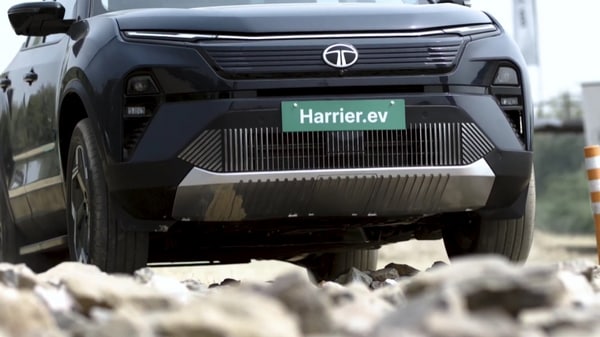
Of all the four thematic areas at the Quad day—Performance, Precision, Tech, and Off-Road—the last one provided the most unique experience at a event like this: a real opportunity to drive. Not as a co-passenger, nor in a closed loop, but rather a genuine, practical crawl through disorder.

And it was chaotic. The off-road course was not a simple slush track; rather, it was a densely packed series of difficult terrain features that would test even experienced ICE SUVs. It started with a rock bed crawl that assessed low-speed handling and wheel articulation, then moved on to an axle twister designed to raise at least one tire off the ground. From there, the path presented steep 35-degree inclines and declines, testing the limits of the vehicle's traction control and braking systems.

The course included side slopes, camel humps, deep sand traps, water wading areas, and even a staircase ascent to complete it all—each obstacle requiring accuracy, composure, and a drivetrain that could adapt quickly. However, it wasn't simply the fact that the Harrier EV accomplished everything that stood out. What stood out was how little it complained while doing so.

No electronic overcorrection, no jerky throttle reaction, and no wheelspin theater. The SUV seemed to have read the course in advance. Every setting—Rock Crawl, Sand, Mud & Ruts—was fine-tuned to provide the right amount of intervention. No more.

This stability comes from a highly specialized drivetrain configuration: a rear-biased Quad Wheel Drive (QWD) system that is driven by two separate motors. The majority of the work is done by the PMSM (Permanent Magnet Synchronous Motor) at the rear. The induction motor at the front only activates when it's necessary.

As Kulkarni, the chief architect behind Tata’s EVs, explained, this decision wasn’t just about traction—it was about efficiency. “PMSM motors are great, but they consume power even when not in use. Induction motors don’t. So for a setup where the front axle is often disengaged, it made perfect sense."

What this means practically is that during a slow rock crawl or a sudden steep climb, the rear motor delivers high torque, while the system dynamically checks whether the front needs to assist. And when it does, the transition is imperceptible.

Even during the axle twister, where one wheel was in the air, the software sensed the slip and reallocated torque within milliseconds. Kulkarni emphasized, “We didn’t use mechanical aids like diff locks. It’s all software. Torque vectoring, traction prediction, terrain mapping—all of it is done by the brain of the car."

And it works. No drama. No mechanical clunks. Just progress

Tech zone: A software-defined vehicle, with Indian priorities

If the Off-Road Zone was about physical proof, the Tech Zone was about technological vision—only this time, grounded in day-to-day Indian reality rather than Silicon Valley showmanship.

Here, the Harrier EV presented itself not just as an electric SUV, but as a Software-Defined Vehicle (SDV)—built on Tata’s new ‘T.idal’ (Tata Intelligent Digital Architecture Layer) platform. Running 500 million lines of code, it connects everything from motor control to ADAS, infotainment, telematics, and payment systems.

But what makes 'T.idal' stand out is not just what it does, but what it consciously chooses not to overdo. It focuses on real-world utility rather than ticking boxes. Take the Low-Speed Autonomous Emergency Braking (AEB), for instance—it’s not just another radar-based system thrown in for formality. It’s carefully calibrated for India’s dense, erratic traffic, where most Western ADAS setups either overreact with sudden braking or disengage altogether.

The Tata Harrier EV gets several convinience features such as the Summon Mode which allows the car to park in a pararell parking without driver inputs

Then there’s Dead-End Assist, a segment-first feature that allows the vehicle to automatically reverse along the last 50 meters of its path—a simple yet brilliant solution for tight lanes and tricky U-turn situations in crowded neighbourhoods. Summon Mode, activated via Tata’s new circular key, lets the SUV inch in or out of tight parking spots autonomously, complete with full obstacle detection.

And the 540° transparent view camera system doesn’t just offer a top-down perspective; it delivers real-time stitched visuals, including side and underbody views, enhanced with rim protection alerts—making it genuinely useful for negotiating potholes, high kerbs, or narrow parking bays.

What impressed me most wasn’t that these features existed—but how calmly they worked. There was no jarring intervention. No frantic beeps. Just consistent, usable assistance. As Kulkarni put it: “ADAS shouldn’t be a backseat driver. It should feel like a co-driver—always watching, but never taking over unless it absolutely has to."

Even the AI-powered Park Assist, developed with Continental, was a lesson in subtlety. The system scanned irregular parking spaces (not laser-marked slots), identified viable options, and parked itself with steering, braking, and acceleration control. And if someone walked by? It stopped. Gently.

Collaboration by design, not compromise

One of the more underrated aspects of the Harrier EV is how thoroughly it has been shaped through partnerships. Tata Motors has embraced a global collaboration model, but with Indian calibration and context firmly at its core. The result is a vehicle that reflects both international technological excellence and local relevance. Continental, for instance, provided the intelligence behind the ADAS suite and Auto Park Assist—custom-developed for India’s unpredictable road realities.

As Prashanth Doraswamy, CEO of Continental India, described it, the system is “a human-like AI that understands Indian parking challenges—unclear lines, sudden obstacles, narrow bays." Harman and Samsung delivered the world’s first 14.5-inch Neo QLED display in a production car, paired with JBL Black’s Dolby Atmos 5.1 audio system—not for flamboyance, but to create a “third space" that seamlessly blends work, entertainment and travel.

On the drivetrain front, Tata AutoComp and Schaeffler engineered the front induction and rear PMSM motors, respectively, with TACO contributing India’s first integrated induction EV drivetrain. The ADAS controller itself runs on Mobileye’s globally benchmarked EyeQ chip, fine-tuned specifically for India’s chaotic traffic environment.

The acti.ev plus architecture, underpinning the Tata Harrier EV is a collaborative effort between Tata Motors and various other leading global suppliers

Qualcomm provides the SDV backbone, enabling over-the-air updates and modular software enhancements, while Bosch, ZF, LG Chem, and Magna form part of Tata’s tier-one ecosystem, supporting everything from battery systems to structural components.

Yet, none of these partnerships were plug-and-play. Each supplier was asked to co-develop, co-calibrate, and rigorously test their systems with Indian use cases in mind. As Kulkarni succinctly put it, “These aren’t just tech tie-ups. They’re part of a new Tata philosophy—collaboration by design."

What the Tata Harrier EV really represents

The Tata Harrier EV doesn’t overwhelm. It impresses with restraint, earns trust through refinement, and redefines what it means to be a true Indian electric SUV. It’s capable where it matters, intelligent where it counts, and most importantly—it feels complete.

With a real-world C75 range of 480–505 km, support for 120 kW fast charging, V2L (Vehicle to Load) and V2V (Vehicle to Vehicle), the Harrier EV isn’t a flash-in-the-pan launch. It’s Tata’s opening move in a much bigger EV play.

More importantly, it’s a product that acknowledges its customer—a 30–40-year-old urban explorer who wants range, refinement, and ruggedness, without feeling like they’re compromising on identity or practicality.

This is an SUV built for weekday office commutes and weekend adventures, for chauffeured comfort and hands-on control, for those who want freedom without friction. In a market where most EVs still struggle to find balance, the Harrier EV finds its footing not in gimmicks, but in grounded, honest capability. And perhaps that’s the boldest move of all.

Read Also: Auto Roundup June 16: 2025 Honda Transalp 750, Citroen C3 Sport Debut & More
Get the latest Bollywood entertainment news, trending celebrity news, latest celebrity news, new movie reviews, latest entertainment news, latest Bollywood news, and Bollywood celebrity fashion & style updates!

HOW DID YOU LIKE THIS ARTICLE? CHOOSE YOUR EMOTICON!
#