









Evolved and Elevated: 2025 Tata Altroz First Drive Experience
6 months ago | 5 Views
The subcompact SUV has taken over our somewhat... enthusiastic automotive market in India, resembling an especially strong monsoon downpour. It seems like everyone needs one. This puts the premium hatchback in an uncomfortable position, don't you think? These hatchbacks have to be demonstrably better in practically every measurable way since they are priced similarly but lack the perceived robustness or commanding view. They are not merely selling their inherent practicality. And Tata, an Indian company that is becoming more and more well-known for its emphasis on quality and, laudably, safety, enters this somewhat competitive fray.
Thus, the Tata Altroz of 2025. It's their most recent competitor in this competitive premium hatchback market, going head-to-head with well-known giants such as the Maruti Suzuki Baleno, which is a true sales success in this nation, and the Hyundai i20, which is somewhat refined. However, the pricing of these luxury hatchbacks indirectly competes for the same money that would have gone to those well-liked subcompact SUVs.
A car must earn its position by being a complete package that offers a combination of attractive style, improved features, and a calm demeanor behind the wheel. The intriguing issue is whether it can actually live up to all those claims and truly differentiate itself in such a competitive environment. And as is customary, we will start by giving the object a thorough inspection.
Design of the 2025 Tata Altroz
Okay, then. The Altroz's somewhat precarious position in the market, competing against both its immediate competitors and the ubiquitous small SUV, has been established. Therefore, how does it try to win this visual conflict? Let's take a closer look at it, okay?
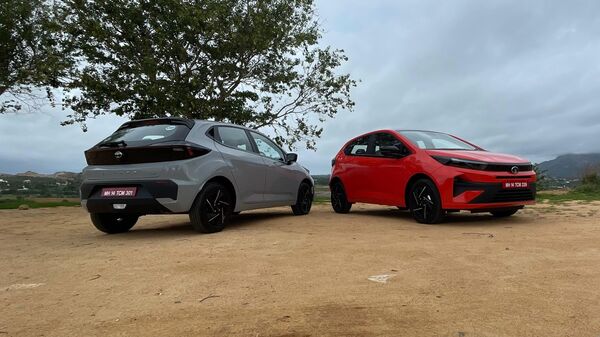
It must be admitted that the Tata Altroz has always been a rather attractive vehicle. Tata, as you can see, has succeeded in giving it a unique presence on the road. Even after this 2025 facelift, its stunning façade is still there. With its striking lines, strong posture, and quiet confidence in its design, it doesn't attempt to be overly flamboyant or beg for attention.

But Tata's strategy for this makeover is what's truly intriguing. Car manufacturers are typically very hesitant to modify metal components during a facelift, such as the hood, doors, and main panels. You see, it's too pricey. But with the Altroz, Tata has really gone to the effort of modifying the door panels. For a simple facelift, that's a pretty big pledge.
Let's begin at the front. The overall appearance is now sleeker and more upscale. New features include remodeled LED headlights, a redesigned and eye-catching LED DRL signature, a new 3D grille, and reprofiled bumpers. Even the LED fog lights have a somewhat more refined appearance. Looking back at you from your rearview mirror, it definitely appears more modern and purposeful.
Go to the side. The modified door panels are useful here. It appeared that the main reason for this was to make room for the new, flush-fitting front door handles. Definitely a bit of a novelty. Everything is tidy and contemporary. Regarding these flush handles, one may naturally worry about dust and dirt, but they are probably designed not to seize up. But they do pose a minor operational problem. As you can see, there are two steps: first, you must push the handle to make it pop out, and then you can pull the lever to open the door. Customers, who are used to just grabbing and pulling, may need some time to adjust to it, in my opinion.

Furthermore, they have gotten rid of some of the superfluous wrinkles that were previously on the doors, giving the side profile a much cleaner, more smooth appearance. It's a minor adjustment, but one that undoubtedly makes the design look better. The 16-inch wheels are also brand new, with a unique design in black and metallic finish. The good news is that all trims include 16-inch tires, even if the expensive alloys are reserved for the more expensive models.
And now, the back. Oh, the back. This is where things become a little complicated. The tail lights are completely new LED devices, and they have wisely included a connected LED light bar that gives the vehicle a wider rear appearance, which is a great feature. The rear bumpers are now more angular and contemporary in appearance, while the Altroz emblem and text are slightly lower. Despite these changes, though, I must admit that the pre-facelift model, in my opinion, had a somewhat more solid position, especially in the back.
Even with that light bar that makes it look considerably wider at night, this new one just seems a little less... settled in the back, though it is still pleasant. Although I'm not sure exactly why, this new one appears to have lost a little of the visual cohesiveness that the previous one had. The integrated door handle on the C-pillar is a design element from the past that is still there and is, well, certainly not a problem.

The Altroz is still a pretty good-looking hatchback overall. The changes to the door panels show that Tata has made an extraordinary effort to maintain the freshness and high quality of its visual appeal. That sense of solidity has also been enhanced by the addition of support to the side structure. It would seem that maintaining the Altroz identity was given a high priority by the head of design, and I absolutely agree with that. It's definitely still an Altroz.
Right, then. Despite the minor oddities in the facelift, we have evaluated the Altroz's exterior appearance, which is quite attractive. We all know, however, that the majority of a car's experience comes from the inside. Therefore, let's unlock the door and enter the inner chamber of the 2025 Altroz to see what Tata has prepared for our enjoyment.
The Tata Altroz 2025: Interior and Amenities
The new beige and black motif is immediately apparent when you enter, especially if you're in one of the higher versions. In contrast to the somber all-black interiors of the past, it employs a two-tone approach. The dashboard itself is brand new, with an illuminated light strip extending across its entire surface.
A new steering wheel welcomes you, with a lighted Tata emblem clearly visible in the middle. Additionally, the top models now include a fully digital instrument cluster, which has a beautiful 10.25-inch display that can show a variety of data, including integrated maps. A new 10.25-inch touchscreen infotainment system is located in the center of the dashboard. The air conditioning and other control panels, which are now mostly touch-based, are located beneath this. But Tata has cleverly kept the physical toggle switches for controlling the fan speed and AC temperature.

The car has a conventional 12V power outlet, 65W Type-C chargers, and wireless charging capabilities. Apple CarPlay and wireless Android Auto are supported. The seats have been redesigned to provide better thigh support for both front and rear passengers, and some trims now include a sunroof. Notably, the camera quality for features like the 360-degree view is excellent, and the digital instrument cluster and infotainment screen are both extremely clear. Also included as standard are safety measures like six airbags.
In terms of space, it's really impressive for a vehicle of this size. Legroom in the back is more than sufficient for the average Indian, and if the seats are on good terms, they can accommodate three adults across. The trunk capacity differs; the gasoline and diesel models have a larger 345 liters, while the iCNG version has a respectable 200 liters because of its ingenious twin-cylinder design.

What are your true thoughts on all of that? From an aesthetic standpoint, the new beige and black motif is indeed a breath of fresh air. In fact, the cabin is opened up, giving it a far more airy atmosphere than the previous, darker arrangement. Only from a visual standpoint, it is definitely beneficial. Additionally, the digital driver's display and main infotainment screen's overall sharpness are superb, representing a significant improvement. In addition, the camera's quality is consistently excellent, especially for parking and maneuvering, which is always reassuring.
But, in spite of all the technology and high-end features Tata has included, the real quality of the interior is sometimes suspect. In a vehicle of this category, cost reduction is to be expected; the use of less expensive plastics in the lower half of the cabin, where there is little contact, is completely understandable. However, even in locations where you frequently interact, you may encounter some pretty fragile plastics. For example, the bottom half of that illuminated logo on the new steering wheel feels extremely flimsy, which is unfortunate since it is a noticeable and tactile element.
And speaking of the steering wheel, even though it looks quite nice, its design actually makes it harder to use the horn, which is a basic function. To properly use the horn, you must frequently take your hand off the wheel to press the bottom half of the illuminated central portion. The majority of vehicles, as you will see, enable you to just poke it with your thumb while maintaining your hand on the steering wheel, which is a small but significant ergonomic feature for our somewhat demanding driving circumstances.

And then there's that new, touch-based control panel for the air conditioning and other features. It has a really premium, sleek, and contemporary appearance, but it mostly prioritizes aesthetics at the expense of functionality. Because those touch-sensitive buttons offer very little to no tactile feedback, you must take your eyes off the road in order to verify that you have indeed pressed the correct location to, for example, turn on the air conditioning or switch to CNG mode. In truth, it's a diversion that one can hardly afford. In this touch-sensitive desert, the retention of real, physical toggle switches for the fan speed and AC temperature is, to their credit, a hint of genuine thoughtfulness. A little consolation, but a sincere one.
Therefore, the Altroz's cockpit. There are ups and downs, aren't there? The screens are exceptionally crisp and the camera quality is excellent, making it a visually appealing and fundamentally roomy experience, all of which is praiseworthy. However, there are a few questionable choices made in the material quality where you least expect it, and in key areas like the steering wheel and some of the central controls, aesthetics clearly outweighs basic ergonomics. Almost there, but not quite the pinnacle of interior design.
We've now examined the Altroz's exterior and explored its somewhat spruced-up inside. However, as you know, a car is intended to be driven, not just a cozy place to sit or a piece of static art. That, my friends, is where the rubber really meets the road. Therefore, let's discuss the driving experience and the oily areas.
2025 Tata Altroz: Handling, ride, and drive
The 2025 Tata Altroz maintains a rather respectable range of powertrain choices for its class, which is commendable. The well-known 1.2-liter naturally aspirated petrol engine, which delivers a respectable 87 horsepower and 115 Nm of torque, is available with a 5-speed manual, a 5-speed AMT, or even a 6-speed DCT for folks who like two pedals. Then, for the more frugal, there is the 1.2-liter petrol-CNG bi-fuel option, which produces 72 horsepower and 103 Newton meters when powered by compressed natural gas and is combined with a five-speed manual transmission.
The 1.5-liter turbo-diesel engine, which is a somewhat unusual selling point in this market. This four-cylinder engine, which is only available with a five-speed manual transmission, produces 89 horsepower and 200 Nm of torque. The pre-facelift Altroz had a 1.2-liter turbo-petrol option (the "Racer" variant, with 120 horsepower), but strangely, the current information for the 2025 model only seems to concentrate on the standard range's naturally aspirated petrol, diesel, and CNG. It's possible that the turbo-petrol will return in the future, but whether or not it's intended for a separate trim is still unknown.

I have to start by saying that I have only had the opportunity, or perhaps the unusual experience, of driving the diesel and CNG models. In this most recent version, the automatic derivatives and naturally aspirated gasoline continue to be unexplored territory for me.
The Altroz is one of the few vehicles in its class that still has a diesel engine. "Ah, diesel – torquey, punchy, good for city driving," one may automatically think. Well, one would be half correct, although not precisely in the manner that one might anticipate.
The diesel's power delivery is notably muted at lower RPM, especially from a standstill. Indeed, it's amazing how much it is. It's often a perfectly achievable, if not exactly elegant, move to start a normal diesel vehicle from a complete stop in second gear. But in the Altroz diesel, I discovered that I was physically unable to perform the task. It doesn't seem like the engine has the power necessary to propel the car forward in that higher gear from a standstill. From a diesel, it requires a firm first gear engagement, which is unexpected but not difficult.
The diesel does, however, start to establish itself as you increase the speed and the engine finds its rhythm. It's a steady, somewhat civilized buildup of momentum, not a quick surge. However, this diesel engine maintains a little sluggishness during fast overtaking maneuvers; you'll need to either plan ahead or perhaps shift gears. But once you're traveling at faster speeds, cruising along the open road, this diesel unit will find a comfortable rhythm. It maintains a steady rhythm without any apparent effort, appearing content. Despite being a diesel, it's a highway cruiser rather than a lively city sprinter.
In terms of the ride quality of the diesel model, it has a little bit of a rigid attitude at slower speeds. In reality, Tata Motors has stated that the facelift includes a re-tuned suspension that is somewhat stiffer than the previous version. Over shattered urban tarmac, this is evident. But at higher speeds, the ride quality becomes really impressive, which is where Tata vehicles frequently excel. It's not too firm, which can hurt your kidneys, and it's not too soft, which can make you feel seasick. It achieves a fair balance by absorbing undulations with a mature and assured attitude. Owners of Tata vehicles frequently claim, and it's a widespread opinion, that their cars have some of the greatest suspension systems in their class. The Altroz diesel, particularly at higher speeds, appears to continue this trend.
The CNG choice is now. It is common to approach CNG alternatives with a degree of caution, assuming that they are somewhat anemic and that fuel economy comes at the expense of overall performance. However, the Altroz CNG truly surpasses expectations in this case. It's really rather quick, which is unexpected!
It actually accelerates noticeably better from a standstill than the diesel. This is a very intriguing anomaly, implying that the CNG system provides either superior low-end torque delivery or a more responsive initial reaction, maybe because of its lower weight or unique tuning for urban driving conditions.

The CNG model has acceptable ride quality at slower urban speeds, absorbing daily flaws well. But on the highway, where you force it to run at faster speeds, it has a propensity to become a little "tossy." This implies that, as opposed to the diesel, it has been genuinely tuned particularly for city driving, where priority is given to agility and low-speed comfort, and possibly less emphasis is placed on absolute high-speed stability.
But the cabin noise in the CNG version is a significant difference. When compared to the diesel variant, it is evident that the noise isolation is not as good. At greater speeds, you may definitely hear more wind noise entering the cabin, which can be a little annoying on extended trips. Additionally, the CNG model's engine gets rather loud at higher RPM, which, frankly, isn't very comforting and somewhat diminishes the overall sophistication.
In essence, the diesel and CNG Altroz each provide a unique driving experience, complete with their own eccentricities and admirable features. In contrast to the CNG, which is a surprisingly lively city slicker that becomes a bit flustered when driven hard on the open road, the diesel is a well-balanced, high-speed cruiser with an odd low-end lethargy.
The Verdict
The 2025 Tata Altroz, then. This premium hatchback is Tata's strong response to India's somewhat SUV-obsessed market, competing with well-known competitors like the Baleno and i20, while also keeping an eye on those small SUVs simply because of its price. It represents Tata's recent emphasis on robustness and, admirably, safety. Undoubtedly, this facelift introduces a few visual oddities, such as those strange modifications to the door panels and that somewhat less well-resolved rear posture when compared to its predecessor, but it is still an attractive vehicle.
The cabin is visually appealing when you enter, with outstanding camera quality and incredibly clear screens. However, it's an odd mixed bag, with some fairly thin plastics in important places and ergonomic choices like the placement of the horn and touch-based AC controls that, to be honest, encourage distraction. It must be noted, though, that space is still a clear advantage. The CNG is a surprisingly energetic companion in the city, albeit it becomes a bit noisy and restless at greater speeds, whereas the diesel provides a distinctive, if somewhat low-end, highway cruising demeanor on the road. Tata's suspension, on the other hand, continues to be a standout feature, handling our diverse road surfaces with amazing maturity.
The Altroz is, in the end, your default option if you are exclusively looking for the market's sole premium diesel hatchback. Without a doubt, it should be on the shortlist for a premium CNG hatchback. It's a fair option for a premium hatchback overall. On the other hand, if you have roughly ₹10 lakh to spend on a new car and want a bit more excitement, it might be wiser to hold out for the turbo-petrol or "Racer" version. Although it may require a thorough analysis of its particular set of compromises and advantages, it is a well-rounded, secure, and practical item.
#